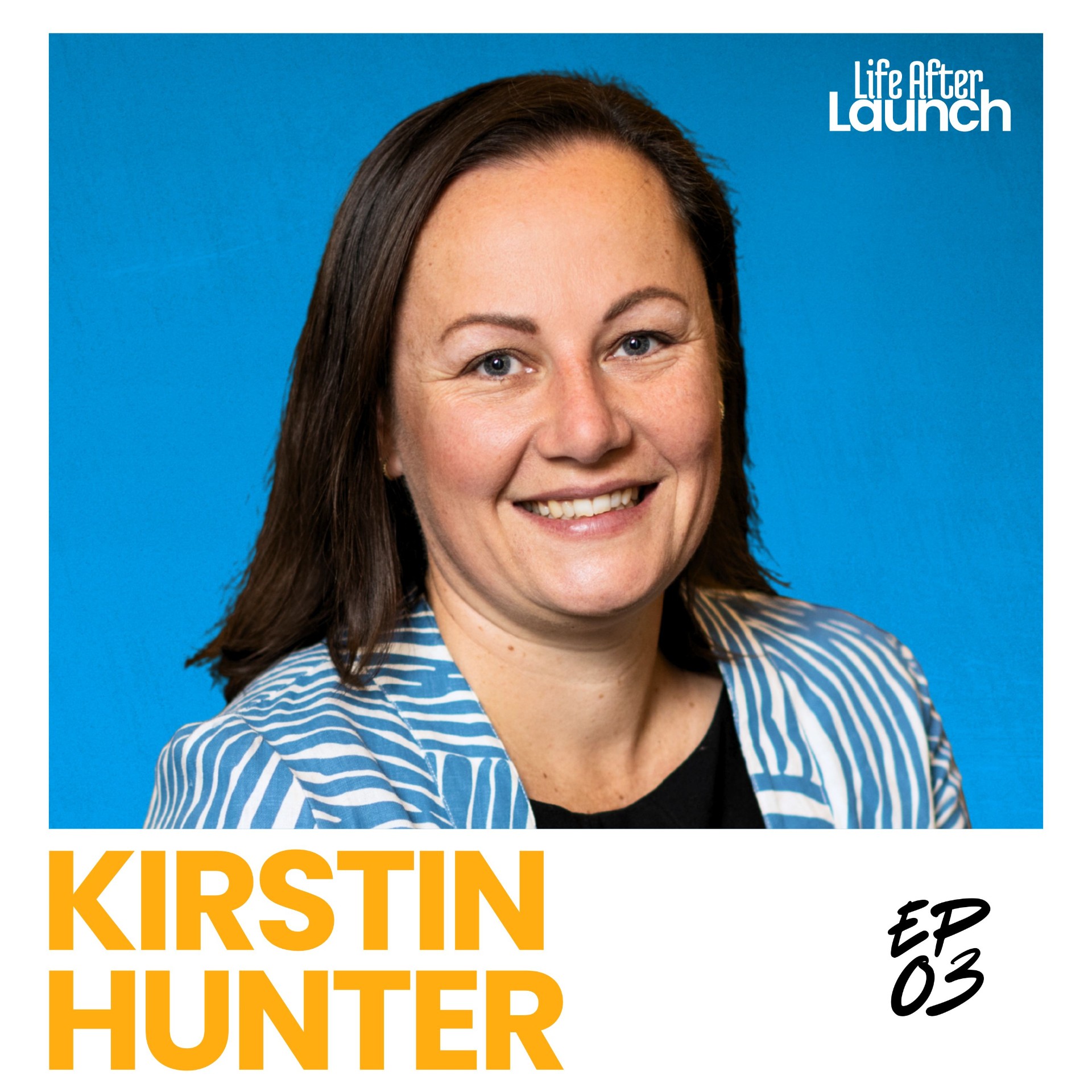
Kirstin Hunter: What use is money on a dead planet? The furthest you can fall is where you are right now.
Megan: Hey, I'm Megan Luttrell. I run Aussie Founders Club, a community for founders, operators, and investors. Largely, we've been an events-first, in-person community for the startup ecosystem, but now we're podcasters. I also run Kairos Recruitment, a recruitment company which supports startups and scale-ups.
Geo: Hi, I'm Geo George, partner at Mayfly Ventures. We're a venture studio that builds industry-focused AI and software ventures. This is the Aussie Founders Club Life After Launch podcast.
Megan: We cut through the startup noise with unscripted stories and tactical advice from the founders who have built before us.
Geo: The show is all about what happens after you launch. The business lessons, the life lessons, and of course everything in between. That's Life After Launch.
Megan: Okay, today's guest is Kirstin Hunter, co-founder and former co-CEO of Future Super, former managing director of Techstars Australia, and now she's the CEO of Birchal.
Geo: Kirstin's been at the pointy end of how startups actually get funded in this country, and probably more importantly, who's getting left out of that conversation.
Megan: And her path to all of this is not a straight line. She grew up in Tweed Heads, first in her family to go to uni, started out in medicine, pivoted to law, then consulting, and then just threw herself into the startup world with this huge ambitious climate mission.
Geo: What I loved about this chat is that she doesn't do the whole polished founder thing. She's just really honest about it all. About the co-founder breakup, about leaving a business that she helped build, about the stats on who gets funded in this country.
Megan: There's a moment early on when she talks about the trinkets, and I reckon that's one that's going to stick with a lot of you. But I'll let her tell the story and we'll just get into it.
Megan: Young Kirstin, what did she imagine for herself when she grew up? What did you think you were going to be?
Kirstin Hunter: Look, I really always thought I was going to be a doctor, like a medical doctor. And part of the reason for that, I think, is I grew up in Tweed Heads, which is a regional area. No one in my immediate family had been to university. The only person in my next generation of family that had been to university was my grandfather, who was a doctor. And I just really looked up to him. We shared a birthday. And so growing up, I was just like, I wanna be like him. And so I moved to Sydney when I started studying medicine way back at the start of the 2000s. And I just had this big experience of like coming to the city and my eyes opening and seeing all of these opportunities that I'd never seen before. And what I kind of realised was I had thought I wanted to do medicine because I wanted to have a career with impact. I knew that I wanted to do something that helped people. And I thought, helping people, be a doctor, job done. But while I was at uni, I got really involved initially in the campus community. So I was from outside of Sydney and I met all of my friends through the university community. And so I was super involved as a volunteer and then ran for the union board and then got elected as president of the union board. And so I found myself at the age of 23 running a company with a $20 million turnover. And just this amazing group of dedicated staff who were so passionate about serving the university community. And I had benefited from that when I was a student. So when I was a customer and now I was on the other side working with the staff who were delivering those services. And it just, I suppose, like really opened my eyes up to the power of business. And I know that sounds a little bit cheesy, but if I'm a doctor in a country town, I can serve however many thousand people, but that's limited by my time. Whereas if I'm leading the UNSW Union, then I'm impacting a community of 40,000. And if I'm in a bigger business, then that community gets even bigger. And so it sort of showed me that business can be a form for impact just as much as more kind of traditional people impact-driven careers. And from there, I transferred into law and then worked as a lawyer and then a consultant and then came across to startups and have just kind of found my way.
Geo: And there's like a common narrative across your work, which is like doing work that's impactful, and it's almost driven by like a social justice type bend. So I'm curious where that drive, that bend for social justice comes from.
Kirstin Hunter: Yeah, I mean, I think coming from outside of Sydney, you sort of always feel - I think when you're from outside of a community that's quite insular like the Sydney business community, you always kind of feel a little bit like an outsider. And so that was part of it as well. As an outsider to the Sydney business community, I didn't really feel bound by the rules of the companies that I worked for in the same way. I think that if you came through with this expectation that you were always going to be a lawyer at this firm, yeah, you kind of want to fit in. Whereas I was like, I don't belong here. Like, what a privilege that I get to be in this space. This is so cool. But also like, I can kind of take it or leave it. And so I think that's part of it. Like, growing up, we moved around a lot when I was a kid, and then my family had a pretty rough time in the '90s recession. And so I remember, like, one of my kind of foundational memories as a kid was all of us sitting around and like folding the junk mail pamphlets because that was what we used to do to get enough money to feed the kids. And so me and my younger brother and sister with my parents folding these pamphlets, and then I would get $0.02 for every letterbox that I put a spam mail in.
Megan: Hmm.
Kirstin Hunter: And it just - I suppose a couple of things happened there. Like, it separated my sense of work equals money, I suppose. Like, you put heaps of effort into delivering junk mail and you get paid an absolute pittance for it. My parents were swimming coaches and they always worked incredibly long hours. And so I've always had this work ethic that's kind of separated from an expectation of reward. And so I think I've carried that with me into my corporate life and into my kind of startup life after that as well. But the way that showed up for me at school was like doing a lot of, you know, like I was a big nerd, so I did all of the kind of student representative council, all of the, you know, extra credit volunteering opportunities. When I started working as a lawyer and then as a management consultant, I was the one who was always like, I'll do that pro bono thing.
Kirstin Hunter: Two cents a letterbox, can you imagine?
Megan: Well, actually I can. I used to get paid about $30 a month, but this isn't about me.
Geo: That's some proper old-school hustling.
Megan: What I love about this whole bit is being from the outside of the system kind of became her thing, right? No networks, no one telling her how it should be done. She just figured it out like all the best founders do.
Geo: Yeah, and you'll hear her come back to this idea a lot. It really does shape how she picks founders, how she builds teams, and how she pushes back on the whole industry. The outsider thing isn't a disadvantage for her. For her, it's the whole point.
Kirstin Hunter: So I was like a second-year lawyer. I represented a claimant in the Aboriginal Trust Fund Repayment Scheme. And so this woman - so I'm like 2 years out of uni and helping this woman, and they got $10,000 from her great-grandfather's wages that were never paid, but you know, to us in corporate Australia, $10,000 is nothing, even as a second-year lawyer. But to this family, it meant that they could have a reunion, like they could see their lost relatives. It just absolutely was life-changing for them. And it was really like very profound, probably life-changing as well for me in a different way, because it showed me like these corporate skills that I'm learning over here in like the literal, at the time, ivory tower of the MLC Centre in Martin Place. Like, they are so valuable for real people. And so how can I find a way of taking this corporate skill set that I'm learning and putting it to practice in a way that drives value for people who otherwise can't afford to pay for it? And so I did a bunch of things of a similar nature when I was a lawyer and then as a management consultant. And it just gave me that sense of, you know, like we are over here in this kind of really elite echelon of corporate Australia where people are paying $1 million a month for us to come in and solve their problems.
Megan: It's absolutely insane.
Kirstin Hunter: It's phenomenal.
Megan: And the amount of money people spend on like getting a consulting proposal just prepared for them and not do anything with it.
Kirstin Hunter: Oh, it's just crazy. And yet that approach to problem solving, that skill set is so valuable when it's put to work for actual real things.
Megan: So was there anything in particular that set you on that path for wanting to do something with purpose and impact though? Like you've talked about, like the way you grew up was different to maybe your peers now. But was there anything that was like, cool, I actually need to go do something that's going to change the world type of thing?
Kirstin Hunter: You know, I think I'd always imagined that I would do something with impact, but what I thought that looked like was being in consulting for however many years and then going and working in a charity. Like, I didn't have another model of what impact could look like. And it was only really, I'd been at Bain for, I don't know, a couple of years, and I saw this partner who was the first time in my corporate career that I'd seen someone more senior than me that I thought, that's what my career could look like.
Megan: Yeah.
Kirstin Hunter: So this partner was involved in a bunch of different charity things. He was on the board of his children's school. Like, he just did stuff that mattered in addition to being really, really good at the day job. And so that was my model for a while, was like, I'll do the corporate day job, I'll do interesting volunteering and kind of, you know, little bits and pieces around the edges to give me that sense of meaning, and that will be enough. But it sort of reached a point, I think, where that wasn't enough. Partly it was due to having my daughter, and that had an impact in 2 ways. The first was that it kind of cut off my promotion trajectory in consulting, and not in a kind of deliberate way. Like, even in 2014, no one would say to you, oh, well, you can't make partner now that you've got a baby. But it was all of the little subtle ways, like no one's ever been promoted to manager before working part-time. And, you know, like the manager that I worked with, it was like, oh, well, if you're only here 4 days a week, then I'm not going to give you the really important piece of work. I'll give that to the junior man who works for you instead of to you. And like all of these little ways that kind of undermine this period in my life where I was better than I'd ever been at the job because I was so focused and so prioritised. But I was being held back by these stupid rules that didn't make sense to me. And so one was like starting to see the cracks in the system and to see the ways in which this system wasn't built for me. And then the other thing I think is, you know, maybe a little bit more clichéd, but when you have a child, you just - your perspective changes. And I was reading a bunch about climate change and 2040. When you have an infant child in 2014, it's just not that long away. I'd always thought of climate change as something that would impact in the far-off future, and all of a sudden my daughter would be 26 years old when these things are going to happen. And so it just made this timeframe much more urgent for me. And I remember having a conversation with a friend of mine who had left consulting before, and he was like, Kirstin, all of the things you do that give you meaning in your consulting work, all of the pro bono things around the side, they're just the trinkets. And you're spending like 95% of your brain on helping companies make more money and you're justifying it by the 5% that you're doing on the trinkets. And it just was really eye-opening. It was the trigger that led for me to come across to Future Super.
Geo: So she goes from knowing, at least intellectually, that the work that she's doing isn't aligned with what she cares about to actually feeling it. When she looks at her daughter and does the math on 2040, she felt it in her gut.
Megan: And she doesn't just sit with it, which is what most of us would do. She actually takes the leap, which with a new baby and a cushy consulting gig is terrifying.
Kirstin Hunter: It was intentional in that I knew I wanted to find something that had more purpose, but I wasn't specifically looking for that opportunity. I'd been interested in the superannuation space before, but really, my job share partner Nicole, who I was working with at Bain - she knew Simon, who was the founder at Future Super. And so together the two of us were job sharing our day jobs, but then we also started doing a bit of advisory work on a job share basis to Simon and Future Super on the side. And one thing led to another and I ended up coming across for a 6-month contract to help build out a new product. And then that turned into permanent and I was there for 4 years and it was this really incredible period of time.
Geo: Like, I think that the need to make that jump into like more purpose-driven work, I think that's so clear, but there's still a big gap to actually make that jump, right? Like, what emotions were you going through? Do you remember actually deciding to take that leap?
Kirstin Hunter: Yeah, I mean, it was terrifying at the time. Like, I was in tears all the time. Like, the decision to go and do a 6-month externship, we called it, which is basically you go and work in a company and you keep the right to come back to the consulting firm afterwards. But then converting that kind of externship role to a permanent role was horrible. Like, it was so traumatic. And it was kind of this funny little posturing with Future Super of like, do you want me to stay? Will I stay? Can we make this kind of economic situation work over here? Like, I would be the biggest hire they'd made, the first kind of really senior person. How can we solve that whole puzzle? And they were sort of like, oh, we don't want to come across as too keen. What if we put it all on the table and she says no? And then at the same time, I had people in the consulting firm kind of really trying to make this out to be a much bigger decision than it was. And by making it hard and stressful and scary, like, I struggled for a long time because going from, you know, big prestigious global consulting firm where your title has value -
Megan: Yeah.
Kirstin Hunter: You know, you walk into a room of your peers and everyone's like, oh, that's Kirstin, she's a case team leader, and you're kind of put on this little pedestal depending on who you're talking to. But similarly with clients, you walk into a room and people are like, oh, that's Kirstin, she's from consulting, we're paying $1 million a month for her and her friends to come in and tell us what to do. Like you have this kind of cachet associated with being a part of that system and coming across into little tiny baby Future Super, there was none of that. There was none of that internally on the team and there was none of it externally either. And so I had to figure out where do I get meaning from my work for me rather than from around me.
Megan: So how many people were at Future Super when you joined?
Kirstin Hunter: It was less than 10. It was maybe around 8 people.
Megan: And then how did you go from being employed on a contract to being co-founder?
Kirstin Hunter: Yeah, I mean, it happened over a number of years, I think. I did have someone suggest to me at the time I first went across that I should try and negotiate a co-founder title, but I thought - how far along were they in their journey at that point? They'd been in market for about a year. So they had around 5,000 members, around $200 million under management, really early. But they thought they were like, we are smashing this, you know, like we're going so well. And they were going incredibly well. But I came in with this, you know, big consulting firm vision and was like, this is a $3 trillion industry and we have something that no one else has. And I reckon people want this, but they just don't know it yet. So I had this really cool opportunity as part of that co-founder team to be the one who brought the really big ambition for the business. And I remember pitching to Simon and Adam, the original co-founders, you know, my vision for what we could achieve in the next 5 years. And they literally were like, this is absurd. Like, in no world do we believe that these numbers are possible, but sure, you go do it. You know, like you can run the team. We're not really that interested in kind of managing people and we know you're the strategist. So whatever you think, we'll just give it a try. And so I'd been there about probably 2 to 3 years before I was recognised as a co-founder.
Megan: Yeah.
Kirstin Hunter: At that point, we were all 3 of us managing directors and then we became co-CEOs. So Future Super launched in 2014. And at the time, there were no other completely fossil fuel-free superannuation options in Australia. Impact investing or ethical investing was kind of what we call best in class. And so it was like, well, we'll invest in Westpac and Commonwealth Bank because they're doing more for the environment, but we won't invest in NAB or ANZ because they're a bit worse. Like you could basically substitute any of the big 4 in that spectrum. I'm not saying that the 2 are better than the others, but it was more like that. It was like, we'll pick the better ones and we won't invest in the worser ones.
Megan: Yeah.
Kirstin Hunter: Whereas we were the first ones that came to market with a really solid negative screen. So we didn't invest in any of the Big 4 banks. We didn't invest in any fossil fuel companies. And that was unheard of at the time. And so this was just as the big consumer awakening around personal impact and climate footprint was starting to happen. The IPCC reports were getting a lot more urgent. And, you know, like KeepCup was in its early days. People were just starting to take their reusable coffee cup. Like it really was the start of this big consumer awakening around climate impact. And I kind of saw that we can be the start of that. Previously, I think they'd sort of had a very narrow view of their ideal customer profile. Like they'd sort of thought our ideal customer votes for the Greens, carries a KeepCup, has donated to at least one GetUp campaign. Like basically they're already in the tent of climate activism. Whereas I took a much broader view and was like, we can be people's first step towards taking action to make their lifestyle reflect their values. We can be that first step and then we can help them take more, but we don't have to have a qualifying threshold for people to already be taking steps themselves before they'll join Future Super. So it really kind of opened up who we were speaking to and how we were bringing members on board.
Megan: You're listening to the Life After Launch podcast.
Geo: If you like the show, here are 3 things that you can do to show us some love. Follow the show, leave a review, and most importantly, share with your friends.
Megan: Okay, so up to this point we've met Kirstin, regional kid, junk mail hustle, ends up co-founding one of the country's most purpose-driven super funds. Great story, right?
Geo: But here's where it really gets interesting, because what happens when the co-founders just stop agreeing on where the business should go?
Megan: This next stretch is tough. Co-founder forks, Techstars curveballs, and then she gets handed the stats on who really gets funded in this country.
Geo: And then she takes us into Birchal, which I reckon might be the most exciting thing that we've talked about in this whole episode.
Megan: Agree, we love Birchal. Let's jump back into it.
Geo: This was the first time you've had a co-founder kind of dynamic. I'm curious to know, like, what did you learn from it? Do you have any advice for new founders navigating some of that co-founder dynamics?
Kirstin Hunter: The co-founder relationship is the most important relationship in the business success.
Geo: Yeah.
Kirstin Hunter: In the early days, we used to spend a lot of time together, just the 3 of us. You know, we'd do co-founder strategy retreats. And a lot of that time was not planning for the business. It was understanding ourselves better. So what actually is each of our personal motivation for why we care about this? Ultimately that ended up being the thing that kind of ended up taking us in a different direction because I was personally motivated by building a movement of consumers, whereas one of my other co-founders was really motivated by having a large amount of funds under management and being able to use that to invest in solar renewable projects. And those 2 things work really well side by side for a little while, where growing the movement of consumers also grows the funds under management. But we reached this point where the faster pathway to grow funds under management was mergers and acquisitions. But that wasn't meeting my motivations.
Megan: Yeah.
Kirstin Hunter: Because then we were bringing in members who weren't making the active choice. They weren't aligning their money with their values. They were being brought into our strategy because of acquisition. And so we had to basically make a choice. And I mean, it wasn't really a choice. The decision was made that we were gonna start going down this mergers and acquisitions pathway. But it was no longer the right thing for me to be the person supporting in that. I left 4 years ago. They've gone from absolute strength to strength. I'm still a shareholder and I'm super proud when I see them do this amazing stuff. But it was the right time for me to leave and go and do other things. And it was incredibly difficult. Like, it was a heart-wrenching decision.
Megan: Yeah.
Kirstin Hunter: And you feel like you're leaving a part of yourself behind when you leave a company that you're a co-founder of. Even though I was the 3rd co-founder, the 2 of them were there from pre-launch, I joined later, it still felt like you're leaving your baby behind. But I kind of had to be like, well, it's my baby, but it's their baby more.
Megan: I also think - because what I was going to try and do was build a platform. Actually, I was getting Jerry to help me with it. And then the more and more I got deeper into the problem solving, the more I was like, I actually don't think the best way to find a co-founder is via an app. And it was going to be paired with psychometric testing. I have a friend who runs a brilliant co-founder psychometric testing place, but I just don't think that the solution is a better app to connect with people. You really need to have some sort of shared experience beforehand, ideally.
Kirstin Hunter: I think being a co-founder as well, like you have to be so all in on the purpose that you're building towards, the mission of the company. It's really hard to match for that, I think.
Megan: Like when people look for a technical co-founder and you're like, how do you get them to care as much about it as you?
Kirstin Hunter: I mean, meanwhile as well, you can get amazing partners who can be just as passionate about your mission, but they're coming at it with their own bent. You can get really great partners who can bring a technical skill set. You know, it's a bit of a - I've seen some horrible co-founder breakdowns. I've seen co-founders exit and it really looks like they're trying to take the business down with them, which is crazy, right? Because generally you always keep a little bit of equity. But, you know, I've seen people try and make the most ridiculous demands of a pre-revenue company to walk away from a co-founder relationship.
Megan: It hits so many spots.
Kirstin Hunter: Yeah, but then you see others where it's like they see the bigger picture and they want the thing to live on even if they're not a part of it.
Megan: Okay, so here's where it gets properly hard. Kirstin and her co-founders have hit this real fork in the road. She wants to keep building the movement organically and they want to scale through merger and acquisition. No one's wrong here. Both paths are valid, but they just can't do both.
Geo: Yeah, and what she does next I think says a lot about who she is. Actually, I'm curious to know even how Techstars came about. Like obviously it is a global brand, a program that's run globally.
Megan: But how did you find it?
Geo: Yeah, like how did you actually bring it to Australia? What was your motivation for it?
Kirstin Hunter: I wasn't involved in the decision to come to Australia. I applied for the job off LinkedIn. So yeah, so Techstars.
Geo: For me, you're like the face of Techstars.
Kirstin Hunter: Yeah. And so Techstars had wanted to get a foothold in, you know, Sydney. And it just so happened that the previous New South Wales government was really focused on building Tech Central. One of the things that they thought would add a real jewel in that crown.
Megan: We think about this type of thing a lot where government is spending money to actually stimulate growth.
Geo: Kudos to government on this one.
Kirstin Hunter: Yeah, no, massive kudos to government. Heaps of foresight and just an amazing partner. But so they really wanted to bring an international accelerator to Sydney, spoke to Techstars, lined it all up, and then they were recruiting an MD and I just happened to be the privileged one who got to do it. So it was such an incredible opportunity because I think as Techstars MD, you are an investor first and foremost, but then you also have this really privileged role as mentor and advisor to the 12 startups that come through the program. And so having that founder experience, but also having kind of the corporate experience behind it, I think gave me this really weirdly well-rounded skill set to be able to help founders regardless of what industry or what kind of market vertical they're chasing, to be able to help them figure out how to solve their problems. The fact that I'd done it before gave me a lot of credibility.
Megan: And then also - a lot of people tell founders how to go through that journey that haven't actually done it.
Kirstin Hunter: And it's totally different when you're on the ground and you're having to, you know, just figure it out and there's no playbook. And then I think as well, like, really importantly, having made the decision to leave and having been through a co-founder breakdown - like those experiences are so valuable because across my accelerators, I think I had 4, maybe 5 co-founder breakdowns. In 24 companies. So it's a high frequency occurrence, but it's not something that many people are very well qualified to speak to.
Geo: Just on that note, like I've recently found out and I kind of suspected, but co-founder breakdowns are one of the leading reasons why startups fail. And I know this because like in my own company, it's a partnership of 3 partners and me and my co-founder, Jo, like we've built this business on the back of nothing. And we were friends before we were business partners and we've always been acutely aware that the success of the business kind of lies in the strength of our relationship. Like, as the years of stress and working in a high-performance environment sort of compounds, you do notice those cracks. And one of the things that we started doing recently is kind of like couples therapy, but for -
Kirstin Hunter: Yeah, absolutely.
Geo: Yeah, co-founders. And it is something that should be spoken about more. Because it's one of the most intense relationships you can have.
Kirstin Hunter: Yeah.
Geo: Like Jo and I often joke about the fact that we've seen each other more than we've seen anyone else in our lives.
Kirstin Hunter: Yeah, totally. And that's why I say I think the co-founder relationship is like being in a marriage with someone. It's just a marriage where you see the person more than your actual life partner.
Megan: Honestly, I always whisper this, but I'm like, my business is more of my identity than anybody else in my life. I don't have a co-founder, but if I had that, that actually probably becomes the single most important relationship.
Geo: Fortunately, like in my case, Jo and I are both very open to and acutely aware of our feelings and emotions. And we do talk about this sort of stuff.
Megan: You guys have a lot of love for each other as well.
Kirstin Hunter: That also helps.
Megan: What I want to ask you on the topic of co-founders - so because my background's recruitment, then I run a community, I could help solve this co-founder problem, right? By combining both of my skills. And I have people coming to me all the time saying, I'm looking for a co-founder. And obviously there's accelerators in Australia where they're like, we need you to have a co-founder because co-founding teams are more successful. But also it's the single biggest reason why startups break down. Do you have a strong preference over co-founding teams versus solo founders? Is it dependent on the person?
Kirstin Hunter: I think it's wholly dependent on the person. I don't have a preference. And in both of the accelerators that I ran, I had a number of sole founders. But I do think that when we were at our best as a trio at Future Super, we were all playing to our strengths and we trusted each other so that the internal communication was really seamless and fluid. When we started to break down was, you know, more people were getting annoyed at other people's weaknesses rather than leaning into the strengths. And I think that there was also kind of a loss of trust, which meant that the communication started taking more work. And, you know, if you don't trust your co-founder to make a call and you're kind of reinterrogating decisions that they've made, then all of a sudden - startups need to operate at pace and all of a sudden your leadership decision-making starts to be the bottleneck and you grind to a slow halt. So how can we replicate that situation where you've got all of the right strengths around the table and you've got the right kind of relationship so that the weaknesses can be mitigated? I don't think that has to be solved in a co-founder relationship, but I think sole founders need to look for ways to solve that. If not in that way, it could be the kind of early staff members that they have. It could be advisors or board members. I mean, it could be friends and family, but they need to find a way to round out their skill set because all founders are spiky. They all have real strengths, but they also have real gaps. And so you want to find someone whose spikes match your non-spikes.
Megan: Yeah.
Kirstin Hunter: And you need to find someone who will call you on your bullshit and will tell you when you're making an irrational decision because it's something that you think rather than something that the market wants or that the data says.
Megan: I think in 2025 as well, we have this uniquely privileged position because I think that a lot of people try and find co-founders, particularly technical co-founders, to fill out that skill gap that they don't have and they don't have a salary to pay someone. So they're like, I need to get a co-founder, I'll give them equity because I can't pay them. And now we can pretty much build whatever we want for quite a low cost, which means you could still bring on a co-founder later, but you have them as an employee first because you validated your product.
Kirstin Hunter: Yeah. And I do have a big bias towards late-stage co-founders because I was one.
Megan: Yeah.
Kirstin Hunter: But I do think that there's something to it, like finding someone who's so passionate about the mission of your company that they'll come and work for you no matter what. And then growing them into being a co-founder, I think is a much better recipe for success.
Megan: We've even seen there's a couple of co-founders on this floor where one was hired and then became co-founder because he got so bought into the mission.
Geo: And you can see that when people are so invested, I call it like controlled obsession. You know, like when people are channeling all of their energy into this one thing, you're like, oh, I'm also doing this. Let's make this a little bit more equitable and formal.
Kirstin Hunter: Yeah, for sure. And it feels different when you find someone who works like that. It's what you need in an early stage startup much more than someone who wants the co-founder title.
Geo: Coming back into Techstars, like one of the things that's so impressive about Techstars and what you've done there is just like the diversity and the theme of empowering often underlooked founders. So keen to hear more about your thoughts on, yeah, how do we bring more equity back into the startup ecosystem?
Megan: The people that I know that are in Techstars are incredible.
Kirstin Hunter: There are so many women founders, founders of colour, migrant founders who are building amazing things, but they don't always have the networks that the more typical archetype of founder in Australia has, and they don't always know how to navigate the system in the same way. So I always loved that about the Techstars mission was that we really saw ourselves as providing the capital, the programs, and the community that founders needed to be successful. We saw ourselves as being for the founders who don't come with these inbuilt networks. I kind of went the extra step because in an accelerator, we were choosing 12 companies at a time. And I think it's impossible to choose 12 unicorns. So don't bother trying.
Geo: Yeah.
Kirstin Hunter: So that gives you a certain number of wildcards that you can use pretty confidently. And what I found was in both of my accelerators, the companies that were kind of like my last picks or even the reserve picks after someone else pulled out, they're the ones that have gone on to have the biggest success. Like, it's kind of crazy, but actually your first instinct isn't always right when it comes to startups. And I found that fascinating. Like, I obviously can't speak to names either at my first instinct or my last instinct, but it really kind of was very humbling to me because it kind of said like, you don't know shit about investing. You know, no one knows anything. We're all just doing our best guess. So why don't we make it fun? And why don't we sort of put a few wide bets on so that we can maximise our exposure to these different things?
Geo: I love this bit. The idea that picking which startups are going to make it based on just vibes is actually kind of unreliable. So you might as well bet on diversity.
Megan: Right? It's such a clever reframe. Instead of pretending you can pick winners, just accept you can't and use that uncertainty to give more people a shot.
Geo: Yeah. Humility as a strategy. I'm very into it. Diversification is such a well-understood concept in investing.
Megan: Exactly.
Geo: But for some reason we just don't apply that to startup investing.
Kirstin Hunter: I think as well, like, you know, coming back to that sort of point we were talking about earlier of being the outsider in a system and challenging the rules of the system, like you see that in the type of businesses that founders who don't match the typical archetype bring to the problems that they solve. They're solving interesting things that are hard problems that impact a large number of people that might not have previously been monetised because they haven't been a problem that the more privileged among us have chosen to focus on. And so, like, I always found that really interesting as well. Like, you just get such interesting business ideas coming from diverse founders, whereas you get, you know, like another AI assistant, another kind of grocery delivery service - it's just not that interesting when you start looking at these kind of opportunities where people just want to be a startup founder. And so they've chosen something that looks really nice on a total addressable market slide, but is kind of soulless when you think about the why behind it.
Geo: Yeah.
Kirstin Hunter: These founders, they've got such dynamic energy, like they pull people to them when you meet them. They find a way because they've been finding a way forever. But the missing piece is money. And so I think that is really where we need to focus. Like, how do we get a pool of money that is allocated in a no-strings way for those founders so that they can access it and show us what they're capable of?
Megan: Yeah.
Kirstin Hunter: Like, who's out there funding the first failure? And I think you really need to think about it in that way, in the same way that I was talking about with, well, I can't pick 12 unicorns, so I've got a few wildcards to throw around here. Let's go crazy. But like, you need to be investing behind diverse founders in the same approach that we're investing in VC around the power law. And, you know, we're going to make 10 bad bets, but if one of them turns out to be a good bet, then they'll pay for the other 10. But instead, what we find is because the numbers are so small with women founders, with diverse founders, migrant founders, founders of colour, LGBTQ founders, like they have such a high hurdle to get over because they're kind of seen as being representative of their whole demographic.
Megan: Yeah.
Kirstin Hunter: And, you know, you see when a women-founded business fails, the fact that this person is a woman and a founder is in the headline of the article. And so we kind of almost have this expectation for diverse founders that they need to prove to us that they will definitely be successful. But that's not how investing works.
Megan: This just brings me back to the state of funding. I went to the panel where they broke it down and basically the question was, why are we seeing less funding going to females? And some of it just made my blood boil as I was sitting in the audience. It's like, we need to see more female founders exit before the money is going to flow back down to them again. And it's like, so what, we need to wait for Canva to IPO even though we know for a fact without IPOing they're killing it? And then the money goes back to the same people who are making the same investment decisions. They're not going to be like, oh cool, Canva IPO'd, I'm now going to invest in more females. What's your take on that? And the excuses that people give?
Kirstin Hunter: I think it's just people will find a way to justify it. And it used to be there aren't enough women applying, and then it was, well, women aren't applying as well as men. And so the excuse just moves. But at the end of the day, it's bias, conscious and unconscious, that is left to go unchecked. And I think the only way to solve that problem is actually by having real quotas put against the numbers. Where are the LPs who are looking at this and saying, hang on, the data says that women-founded businesses perform better, that diverse teams make better decisions. Why are you investing 98% of my funding into teams with at least one man? Like, get your shit together and do a better job of investing the money.
Megan: Because they're not even investing their own money. They're spending somebody else's money to perpetuate a bad system.
Geo: It is an entrenched power structure as well. Like, there's a lot of psychology that you can use to arrive at some sort of an answer as to why the outcomes are bad. But the reality is the outcomes are bad, you know?
Kirstin Hunter: Yeah, exactly. And my take on this is, I've been through this whole journey in this. And I think when I started at Future Super, we had one of those pre-2021 capital raising experiences that you only dream of today. Like we literally went to our first meeting and we closed the round in the first meeting. Like, it was wild. Like, the fund invested and a bunch of their LPs invested individually as well. Our second round, our Series B, was slightly more work, but only just.
Megan: Yeah.
Kirstin Hunter: Like, we got a lead investor really easily. The rest of the round was filled. It was probably oversubscribed. But, you know, like, it was pre-2021. And so capital was flowing a bit more smoothly. And I just thought, this is fine, you know, like I just raised capital. This is easy. And then I kind of left and I worked at Brighte, which was led by Katherine McConnell, who's this incredible woman sole founder. She just raised $100 million. And I was like, women founders are killing this. Then last year we did the Funding the Balance work, Preeti Mohan and I, where we tried to kind of hold the individual VC funds accountable. And we were looking at the funding announcements, which is a subset of funding, but the stories that we tell about who gets money are important. And we cut it by VC. And our idea was we'll have this leaderboard and we'll show up who are the good VC funds and who are the laggards, and we'll put pressure on the bad guys to catch up.
Megan: I love that.
Kirstin Hunter: But what we found was everyone was so bad, actually, it seemed like it more empowered everyone to do less because they saw how little everyone else was doing. And so Alice Anderson was the number one from the get-go because they only invest into women founders. And then it was Daylight. But they only invest in Victoria. And so this government Victoria-owned fund was leading for investment into women-founded businesses. And then it was like a battle for second and third. And I think to get third place, you only had to invest in 2. Yeah, it was so bad that then we just stopped doing it because it was like, we're just empowering the system to do less by showing how bad everyone is.
Megan: I feel like this perfectly segues into Birchal though, right? You're democratising funding for founders. Can you tell us how that came about?
Kirstin Hunter: And so, yeah, I think that's exactly right. Like, and this kind of takes me back to, well, I'm just going to build it. Like, I'm just going to build the system that I want to exist and we'll just wait for other people to follow. So I mean, for me, this opportunity kind of came up in a really interesting way. I wasn't looking for a job. I had another year in my contract with Techstars to go. But Kate O'Keefe, who was one of the founders in my Techstars program, was on the Birchal board. And so when Matt Vitale announced that he was stepping down, Kate reached out to me knowing that I just finished the accelerator. I had my quiet 6 months ahead of me. Lol, quiet 6 months. She was like, what are you doing? Can you come and help us out at Birchal? And I was like, absolutely not. I have a job that I love, but I'll come and help the board find the new CEO. And so I originally started -
Megan: And you also have to fly in for the job as well.
Kirstin Hunter: Exactly. And I hate work travel. I did enough of that in corporate. But yeah, so I was originally just advising the board on the CEO search. But the more I kind of met with the team, explored the space, the more I was like, you know what, actually, this is kind of perfect for me. It's all of the work around retail investors and helping everyday Australians get access to these investment opportunities that they're otherwise shut out of. That was the core of what I was doing at Future Super. It's helping founders who are not able to access capital through the traditional means a lot of the time, or those that are kind of a bit more savvy and see the strategic opportunity of raising from the crowd, connecting them with sources of capital that meet their needs. So it really kind of brings my 2 biggest roles together in this really beautiful way. And it gives me the chance to be sole CEO for the first time in my career and to take something that Matt and Alan, the 2 original co-founders, have built and gotten to a certain point that now I can take over and run with it.
Geo: And you highlighted that the funding is sort of the missing piece of the puzzle. And I do think this democratisation of funding is some part of a solution to a more equitable kind of startup ecosystem. I'm curious, what's your best case for crowdfunding? Like, why crowdfunding and why now?
Kirstin Hunter: The thing that I really love about it is it gives everyday people the opportunity to shape the market that we live in, you know, and to do that with their dollars. I love the fact that a company can come on Birchal with an amazing strong community and turn that community into shareholders who can then benefit when they're successful. I also love the fact that companies can come on without a community and can use the process of raising capital to build that community to set them up for their future success. Like, I just think there's so many great potential stories here. And not only that, you know, it is an opportunity for wealth creation for everyday people who deserve the opportunity to invest in great ideas. And our crowdsourced funding regime in Australia is only about 8 years old, but in the UK they've got an extra 10 years on us. We've just seen a couple of examples in Monzo and Revolut where the early crowdfunded investors - so Revolut, they had 460 or so investors in their initial round with an average of £2,000 per investment. That £2,000 investment in their first round is now worth over £1 million.
Geo: Oh my God.
Kirstin Hunter: Even factoring in dilution. So you could potentially have 460-odd new millionaires off the back of this investment.
Geo: Like, this is exactly what I'm hoping for.
Kirstin Hunter: Yeah, that's what it's about, you know, is like, how can we - and I think so much in all of my jobs, I think about my parents, swimming coaches up on the Gold Coast. Like, how can they access these investment opportunities that otherwise you have to have a minimum ticket size of a quarter of a million dollars to be able to buy into the latest VC fund? Like, how can we democratise that and give everyone a chance to choose what ideas are going to work? And then also, I think operating well, that should give companies who are raising through crowdfunding an indicator of traction. It should give them this incredibly loyal customer base who's literally invested in their success. Like, it should be this real kind of virtuous circle of funding and commercial strength in the commercial relationship and then the successful business outcomes that follow. The few companies that actually have raised VC investment and still come to crowdfunding - Unyoked is a really good example, but we've also had Savannah Asset Management and Cashew in the last couple of weeks where each of them has had VC investment. Unyoked was, I think, their third raise on crowdfunding where they had private investment capital, and then they brought some of their investment to the crowd as well because they so much believed in the value of the crowd investment in terms of letting your customers be your shareholders, giving your shareholders the opportunity to benefit from your company's success. Like, I just think that is a really cool kind of recent development. We're seeing more and more companies do that.
Megan: We know one of the founders of Birchal, Alan Crabbe, and loved hearing Kirstin's perspective on it because she spent, what, a decade watching founders get locked out of funding, and now she's running this platform, a platform we love, that could actually change who gets to invest and who gets invested in.
Geo: And it's not some hypothetical game. The Revolut numbers alone, like £2,000 turning into over a million quid - that's some serious generational wealth. That's through crowdfunding.
Megan: Wild. I love it.
Kirstin Hunter: We just can't keep not fixing things.
Geo: Okay, so in this one episode, we went from Tweed Heads and junk mail at 2 cents a letterbox to a platform that could mint 460 new millionaires.
Megan: When you put it like that.
Geo: I know, but that's kind of the through line with Kirstin, right? She keeps building things that don't wait for permission. Fossil fuel-free super fund, diverse Techstars cohorts, democratised equity investing - it's all the same muscle.
Megan: The bit that I keep coming back to is the trinkets moment. Just the idea that you could be spending 95% of your energy on something that doesn't matter to you and only 5% on what does - like, if that's not a gut check, I don't know what is. And honestly, huge thanks to Kirstin, especially for being so open about the co-founder stuff. That line, I want this purpose to survive the loss of me, I think that's a really healthy way to think about purpose.
Geo: All right, if you got something out of this one, please leave us a review and share it with a founder mate, especially if they're wrestling with their own fork in the road.
Megan: Or someone who's been told they don't fit the mould.
Geo: Exactly.
Megan: I'm Megan Luttrell.
Geo: And I'm Geo George.
Megan: Catch you next time.